Here’s the thing about bot detection: when you, as a human, look at a bot account, you can almost always tell immediately. Maybe it’s an empty bio, a weird posting pattern, generic replies, overly flirtatious behavior. It’s not always the same, but it takes you about two seconds and you know.
That ability to just look at a profile and know it’s fake was, until recently, exclusively a human skill. Traditional bot detection tools couldn’t do it. They relied on rigid rules: flag anyone with fewer than 50 followers, or anyone following more than 5,000 accounts. That catches obvious cases - sometimes - but it also flags real people who just happen to be new or follow a lot of accounts. And bots adapt easily, because the rules are simple and predictable.
LLMs changed this completely. For the first time, software can look at a profile the way you do: read the bio, scan the tweets, notice that the “engagement” is all generic replies to unrelated threads. It’s the same judgment call you’d make, but at scale.
The catch is that despite this capability existing, actually building it into a working product is not straightforward. X doesn’t do it for you. And most third-party services are still doing it the old way, with rules and heuristics that haven’t kept up with how sophisticated bots have become. And the problem is only getting worse. According to CHEQ’s 2024 State of Fake Traffic report, bot traffic across social platforms hit 18% of all activity, with X/Twitter among the worst offenders.
Let’s take a look at what tools are out there.
What to Look For in a Bot Detection Tool
Before jumping into the list, here’s what separates useful tools from the ones that waste your time.
Detection method. This is the biggest differentiator. Rule-based tools flag accounts using simple thresholds: “fewer than 50 followers” or “following more than 1,000 people.” LLM-based tools analyze tweet content, posting patterns, and profile details together, the way a human would. Rules catch obvious bots. LLMs do too, but they also catch the evasive ones. Research from Carnegie Mellon’s Bot Observatory has shown that even sophisticated statistical models struggle with the newest generation of bots, which is why content-aware approaches have become necessary.
Coverage. Does the tool scan your entire follower list, or just individual accounts? Some tools only check one profile at a time. Others can audit thousands of followers in a single run. Does it scan a followers list - and is it only your own followers or any accounts’ followers?
Speed. Browser extensions that scrape Twitter’s UI are slow. They process accounts one at a time while you keep a tab open. Server-side tools run in the background and can analyze hundreds of profiles per minute.
Pricing. Free tools exist, but they’re limited. The question is whether the paid option gives you enough extra value to justify the cost.
Output. A percentage score is nice. A report with per-account evidence you can share with your team is better. The best tools give you both.
Tool-by-Tool Breakdown
1. Bot Hound
Bot Hound is the LLM-based approach described above, built into a product. You can run a bot check on any public account, not just your own, which makes it useful for vetting influencers, auditing competitors, or checking your own follower list.
How it works. Bot Hound samples a random subset of an account’s followers and sends each one to an LLM for classification. The model reads the account’s tweets, bio, and profile metadata and makes the same kind of judgment call a human would: does this look like a real person? It doesn’t rely on follower-count thresholds or simple rules. The sampling approach keeps costs down and results fast, while still giving you a statistically reliable picture of audience quality - and you can always choose 100% sampling for a full scan.
Here’s what the AI actually catches in practice:
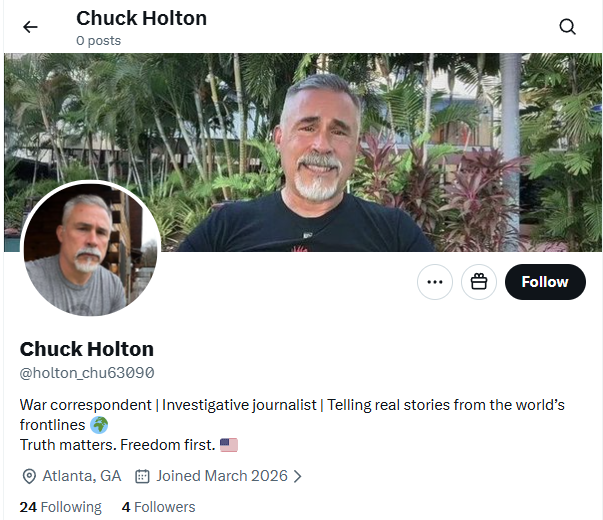 The AI flagged this as impersonation of a known journalist. Brand new account, zero posts, stolen identity.
 Verified badge doesn’t fool the AI. This account posted 7,005 times in two months - obvious automation.
 AI caught the bio/content mismatch. Claims to be an oncologist, but all activity is crypto spam and his bio was truncated in the copy/paste (“to beat their diagnosis”).
These are the kinds of accounts that rule-based tools miss entirely. Just ask the Queensland University of Technology - they found in a 2024 study that LLM-based detection significantly outperforms traditional heuristic methods on modern bot accounts, precisely because bots have learned to game simple metrics like follower counts and account age.
What you get. Each sampled follower receives a bot probability score with evidence and reasons for why it was flagged. The report includes two visualizations: a bot probability distribution showing the spread from “likely human” to “likely bot,” and an audience composition chart that breaks down bot rates by follower recency (so you can see if someone recently purchased followers vs. accumulated bots over time). The full report is shareable, which is useful if you’re an agency presenting findings to a client.
Pricing. Bot checks start at $5 per report, scaling with the size of the scan and how far back it goes in a follower list.
Bot Hound also offers a Bot Blocker subscription — $5/month for always-on protection that automatically scans and blocks bot followers as they appear. No other tool in this list offers ongoing automated blocking.
Best for: On-demand audience audits, agency vetting, always-on bot blocking, and anyone who needs a shareable report with per-account evidence.
Limitations. Call us biased, but not many! The AI classification is very capable but as with any tool, it’s not infallible. We’ve seen it occasionally flag very low-activity real accounts as suspicious, especially accounts that tweet rarely and have sparse profiles. It also only covers X (Twitter), not other platforms - at least not yet.
2. Bot Sentinel
One of the earliest bot detection tools, founded in 2018 by Christopher Bouzy. It used machine learning to analyze tweet content and assign “problematic” ratings to accounts on a 0-100 scale.
Current status. Bot Sentinel lost API access to X in 2022 and has been offline since. Bot Sentinel v3.0 is set to relaunch on May 1, 2026 with “cutting-edge AI tools to detect inauthentic behavior, analyze networks, and help you keep conversations healthy.”
How it worked. Bot Sentinel went beyond simple bot detection. It focused on identifying “problematic” accounts, a category that included bots, trolls, and coordinated inauthentic behavior.
Best for: Worth watching after the relaunch. The v3.0 focus on network analysis and inauthentic behavior detection is a different angle from per-account audience quality audits. Their site describes it as identifying broad, coordinated rumors and narratives.
Limitations. Not currently available. The relaunch details are sparse, so it’s unclear exactly what the new version will offer or how it will compare.
3. X Bot Remover (Chrome Extension)
The most popular standalone bot blocker right now. It’s a free, open-source Chrome extension.
How it works. X Bot Remover uses configurable rules: accounts with fewer than 50 followers, following more than 1,000, with zero posts get flagged. You can adjust the thresholds and add filters for default profile pics, digits in usernames, and bio keywords.
Best for: Quick, free cleanup if you’re comfortable with browser extensions and don’t mind keeping a tab open.
Limitations. It runs entirely in your browser. You have to keep the tab open and can’t interact with the page while it scans. It processes followers one at a time, so large accounts take a long time. The rule-based approach catches very blatant bots but misses the full contextual perspective that AI leverages.
4. Twitter/X’s Built-in Tools
X lets you report individual accounts as spam or bots, or block them manually. The platform also runs periodic sweeps that remove millions of bot accounts at once.
Best for: Reporting individual bots you stumble across.
Limitations. X’s tools are reactive, not proactive. You can’t audit a follower list. You can’t get a bot percentage. You can’t bulk-review suspicious accounts. When X does run bot sweeps, the bots come back. If you need to understand the quality of an account’s audience, X’s built-in tools won’t get you there.
5. Manual Audit
You can always click through profiles yourself. Look for default avatars, empty bios, zero tweets, extreme follower ratios, and recent creation dates.
Best for: Learning what bots look like. Checking a handful of specific accounts you’re suspicious about.
Limitations. This works for maybe 20 to 50 accounts. After that, it’s hours of clicking and scrolling. If an account has 2,000 followers, a manual audit would take days - and many accounts have far more than that. Sophisticated bots with profile photos, plausible bios, and a few generic tweets will slip right past you. Spend that time on better things.
6. SparkToro, HypeAuditor, and Influencer Platforms
Platforms like SparkToro, HypeAuditor, Modash, and CreatorIQ include audience quality scores as part of broader influencer marketing suites. They’re designed for brands evaluating whether an influencer’s audience is real before spending money on a campaign.
How they work. These platforms aggregate data across millions of creator profiles and assign quality scores. HypeAuditor uses an Audience Quality Score (AQS) based on 53+ fraud patterns. SparkToro focuses more on audience research (where your audience spends time online) and has actually pivoted away from its fake follower detection feature.
Pricing. These are subscription products aimed at marketing teams. HypeAuditor starts at $299/month (annual billing). SparkToro starts at $50/month. Modash and CreatorIQ are enterprise-priced, often $10,000 or more per year.
Best for: Brands and agencies running influencer campaigns who need audience quality data across multiple platforms (Instagram, TikTok, YouTube, X).
Limitations. Expensive, and most of these platforms are strongest on Instagram and TikTok, with X/Twitter support being secondary or minimal. If you only need X/Twitter audience analysis, you’re paying for a lot of features you won’t use.
Comparison Table
| Feature | Bot Hound | Bot Sentinel | X Bot Remover | X Built-in | Manual | Influencer Platforms |
|---|---|---|---|---|---|---|
| Detection method | AI (tweet + bio + behavior) | ML on tweets (relaunching) | Rule-based | Reactive reports | Human judgment | Heuristic scoring |
| Check any account | Yes | Was yes | Your own only | Your own only | Any | Varies |
| Shareable report | Yes | No | No | No | No | Yes |
| Tweet content analysis | Yes | Was yes | No | No | Painful | No |
| Supports sampling | Yes | No | No | N/A | N/A | Varies |
| Pricing | From $5/report | TBD (was free) | Free | Free | Free | $50-$300+/month |
| X/Twitter coverage | Full | Was full | Full | Full | Full | Partial |
| Multi-platform | No | TBD | No | N/A | N/A | Yes |
Which Tool Should You Use?
It depends on what you’re trying to do.
If you want a quick, free scan of your own followers: X Bot Remover is solid for catching obvious bots. Install the extension, run it, and clean up the clear-cut fakes. Just know it won’t catch the sophisticated ones.
If you want a detailed audit of any account: Bot Hound’s bot check gives you a sampled breakdown with AI-powered classification and a shareable report. This is what agencies use when vetting influencers before signing a deal.
If you’re running influencer campaigns at scale: HypeAuditor or a similar platform makes sense if you need audience quality data across multiple social platforms, not just X.
If you’re watching for disinformation networks: Keep an eye on Bot Sentinel’s relaunch. Their focus on coordinated manipulation is different from audience quality checks, and could be valuable for researchers and journalists.
No single tool is perfect for everyone. The best approach for most people is to start with a one-time audit to understand how big the problem is, then decide whether ongoing monitoring is worth the cost.
Ready to find out how many of your followers are bots? Try Bot Hound’s bot check.