Your Numbers Are Working Against You
You’ve been putting out good content, growing your audience, and your engagement seems… fine. Not great. You check your engagement rate and it’s sitting around 2%. Average for X. Nothing to worry about, right?
Maybe. Or maybe your real engagement rate is 3-4% and you can’t see it because a few thousand bot accounts are dragging your numbers down. You didn’t ask for them. You probably don’t even know they’re there. But they’re costing you reach, and they might be costing you deals.
Think of it like barnacles on a ship hull. The ship still moves. It still looks like a ship. But it’s slower than it should be, burning more fuel to go the same distance, and the problem gets worse the longer you ignore it.
The Algorithm Is Punishing You for Followers You Never Asked For
This is the part most people don’t realize. Bot followers don’t just sit in your follower list doing nothing. They actively suppress the reach of every post you publish.
X’s algorithm uses early engagement as a quality signal. When you post something, X shows it to a sample of your followers first. If that sample engages, the post gets pushed to more people. If it doesn’t, distribution stops. X’s open-sourced recommendation algorithm confirms that these early signals heavily influence reach.
Bot followers don’t engage. Analysis of bot behavior on X shows they might occasionally like or retweet, but they almost never reply, never have real conversations, and never convert. So every time X’s initial sample includes bot followers, your post looks like it’s underperforming. Distribution gets throttled before your real audience even sees it.
This creates a feedback loop. Lower visible engagement leads to less distribution, which means fewer real people see your posts, which leads to even lower engagement. Your content isn’t getting worse. The algorithm is reacting to a polluted signal. You’re putting out the same effort, but the barnacles are creating drag the algorithm can feel even if you can’t.
Your Engagement Rate Is a Lie (in Your Favor… and Against It)
Engagement rate is engagements divided by followers. When bots inflate your follower count, they push the rate down even if your real engagement hasn’t changed.
Simple example: say you have 10,000 followers and get 300 engagements per post. That’s a 3% engagement rate. Now say 3,000 of those followers are bots. Your real audience is 7,000 people, and 300 of them are engaging. That’s actually a 4.3% rate. You look average when you’re actually well above average.
But here’s where it gets worse. Because the algorithm is suppressing your reach (see above), you’re not even getting the 300 engagements you would with a clean list. You might be getting 200, because your posts aren’t reaching as many of those 7,000 real followers. So your visible engagement rate tanks to 2%, and the real rate you could achieve with a clean list would be something like 4-5%.
The bots aren’t just inflating a denominator. They’re shrinking the numerator too, by throttling distribution to the people who actually want to see your posts.
This Is Costing You Money
The influencer marketing industry has shifted hard toward engagement-based pricing. Influencer Marketing Hub’s 2025 data shows that engagement rate now drives 65% of pricing decisions, up from 45% two years ago. 73% of brands prioritize engagement rate over raw follower count when selecting creators.
The standard pricing formula looks something like:
Rate = follower count x engagement rate x rate per engagement
When your engagement rate is being suppressed by bot pollution, that formula spits out a lower number than you deserve. The creators getting the better deals aren’t necessarily making better content. They might just have cleaner follower lists, so their metrics actually reflect their real audience. A clean hull, same ocean.
And increasingly, brands and agencies are running bot audits before signing deals. HypeAuditor’s 2024 report found that fake followers cost the influencer marketing industry billions annually, and savvy buyers are screening for it. If a brand checks your account and finds a 30% bot rate, that’s a conversation you don’t want to have, even if every one of those bots followed you without your knowledge.
They Keep Coming
The bot problem doesn’t fix itself. Like barnacles, they accumulate. Leave them long enough and the drag compounds.
A large-scale study published in Nature analyzed roughly 200 million users across seven major global events and found that bot accounts deliberately target human networks. On average, a bot’s connections are 90% human and only 10% other bots. They’re not clustering together in some bot ghetto. They’re embedding themselves in real audiences.
The more active and visible you are, the more bots you attract. They follow accounts like yours to look legitimate and avoid getting suspended. Some are running engagement farming operations. Some are trying to DM your real followers with scam links. And once they’re in your follower list, they attract more of the same. If you’re a creator dealing with a steady stream of bot followers, auto-blocking for creators explains how to stop them before they settle in.
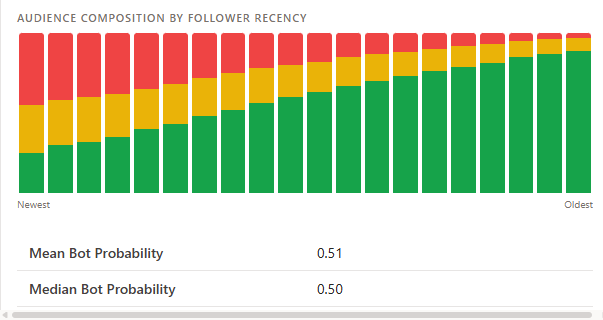 This is what gradual bot infestation looks like in a Bot Hound report. The oldest followers (right) are mostly real. But the bot ratio has been creeping up steadily, and the newest followers are nearly half bots.
Scrape the Hull

Most creators have some bot followers. The question is whether it’s 5% (normal background noise) or 25%+ (a real drag on your reach and revenue). We’ve seen some very large accounts reach well over 50%.
Run a Bot Hound bot check on your own account. You’ll get a breakdown of your audience: what percentage is real, what percentage is bots, and per-account evidence for every flagged follower. If the numbers look clean, great. You’ve got proof you can show to any brand that asks.
If they don’t look clean, Bot Hound’s Bot Blocker scans every new follower automatically and blocks bots before they settle in. $5/month, 14-day free trial. Scrape the hull, and your real speed shows through.